Despite the oppressive August heat, along fences and trellises throughout my new garden located in Maryland 7b, three different clematis vines bloom. Next year, they, along with my roses, lavender, and other flowers, should pop with vibrant complementary colors!
Here’s a peak…
Jackmanii
Nestled between the purple and pink clematis is Summer Romance, a pink floribunda rose.
Dr. Ruppel
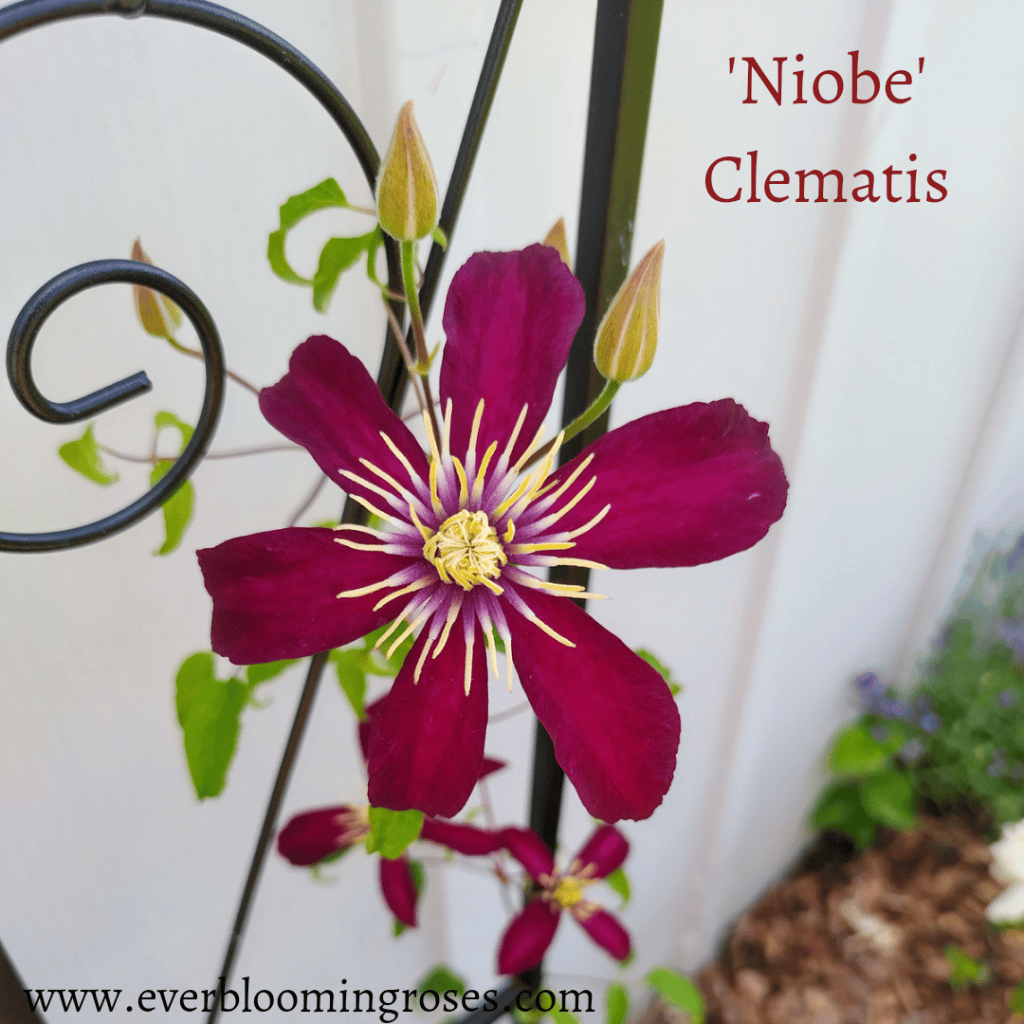
Niobe
The gold in the center of this Niobe will go nicely with the gold of Eternal Flame, a hybrid tea rose.
As the plants prosper and acclimate, there should be plenty of photo opportunities to capture the clematis and roses highlighting each other’s beauty like good friends or perhaps like a summer romance or eternal flame often do. 😉
Bring out the best in others! Highlight beautiful character in those planted near you. Be complementary! Be ever-blooming.
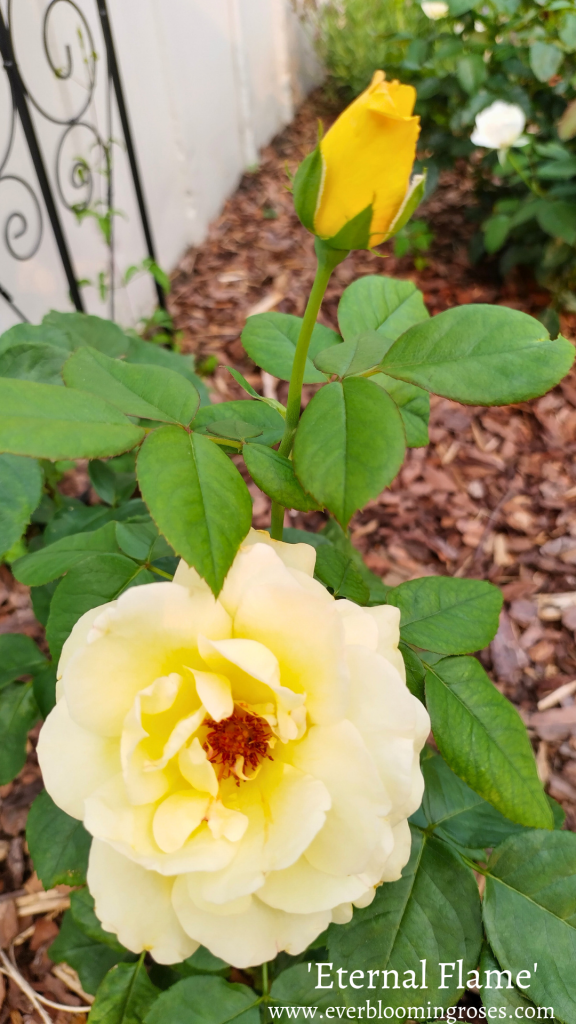
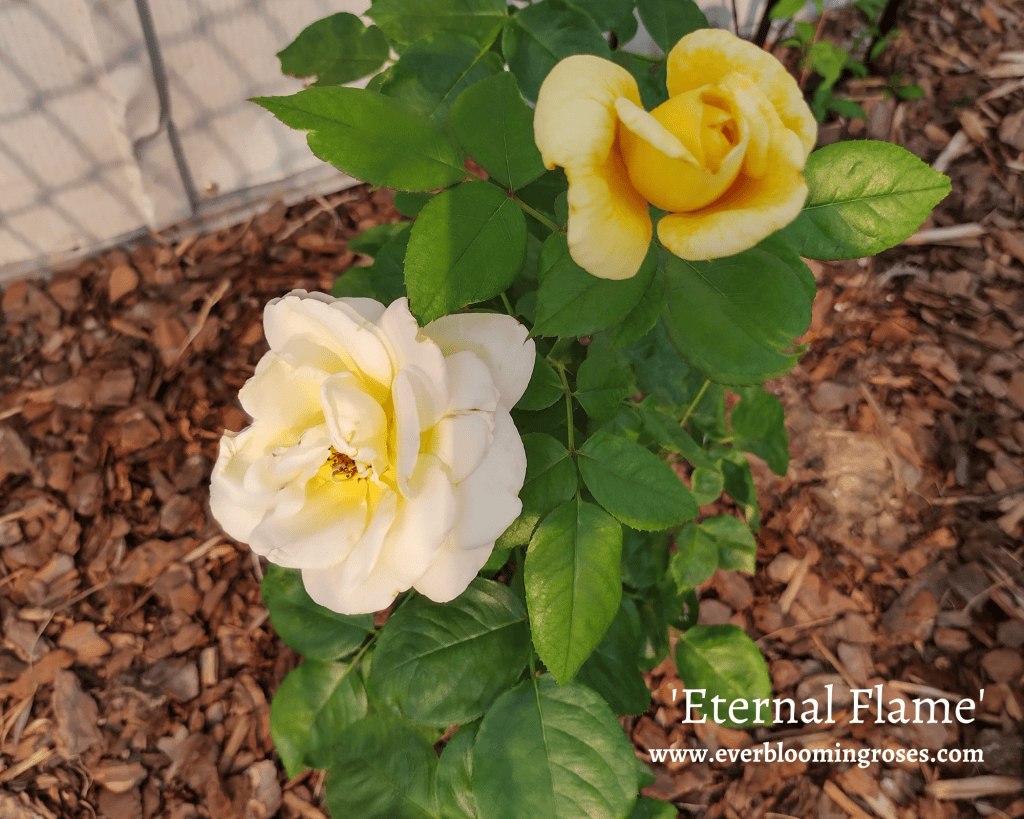
This is a fragrant, yellow hybrid tea rose known as ‘Eternal Flame’. Soon, the bush will be tall and narrow. I suppose like a flame.
I planted this rose in my garden because the name ‘Eternal Flame’ reminds me of the eternal flame burning at the altar described in Scripture. In synagogues, the eternal flame or lamp hovers above the ark. The ark is like an ornate wooden chamber that houses Torah scrolls. What’s Torah, you ask? The first five books of the Bible. Various Scriptures also refer to Torah as the light. Also, some churches have a lamp, or eternal flame, over their altar.
One meaningful lesson I learned in my Jewish studies is if you are manifesting fear or anxiety, it reveals you are not trusting in God. The fruit reveals the root. “Bitachon” is the Hebrew word for trust, which is different than faith or “emunah”. Faith is more of head knowledge or belief God exists; whereas, trust is a posture of the heart, surrendering action, or a response deep within to God’s will and authority in your circumstances — His control in it all and God’s motivation to benefit you in it all. Challenging circumstances are opportunities of bitachon designed to develop greater holiness in you. Deep calls unto deep. Moreover, faith without action, without trust, or emunah divorced from bitachon, is meaningless. But together, they produce shalom…peace… wholeness… security and other manifestations of holiness. Trust in Adonai. ☝️ He’s got this.
To all the hurting Mamas, these things I know for certain: wait on God, trust He’ll work it out, and know that worshipping God changes everything…In His time and His way. I hope all the various types of Mamas and children of all ages have a meaningful, ever-blooming day despite life’s prickles. God sees all and reveals truth. He also is writing your story and planting a garden of hope in you.
The rose buds featured in this photo symbolize my children.
Many forms of captivity may manifest in our lives beckoning our very own exodus. One such form of captivity I personally experienced was domestic and familial violence, that is violence or other forms of abuse committed towards me by a spouse as well as a close family member. Sometimes people who you thought would protect and provide for you choose to oppress you much to your shock and horror. Nevertheless, the story of Joseph’s family oppressing him (in the Bible) reminds me that God can use all circumstances for your good and the benefit of others as well. Later on, in Scripture, God hears the cries of the oppressed descendants of Joseph and his family and sends Moses to let God’s people go. Hence, the exodus story. After cultivating my exodus from such “pestilence”, God used gardening to help heal my heart and mind. With a heart full of gratitude towards God for graciously hearing my desperate prayers, I want to use my life to help cultivate growth in others who may still be awaiting an exodus of their own.
Due to these traumatic experiences and wanting to help others still in captivity, I became a certified domestic violence advocate that not only held faith-based support groups in my home for victims of domestic violence, but I also went on to found a non-profit that housed pregnant survivors of domestic violence and their children. Although I no longer house hurting women, I find myself still wanting to encourage those who are suffering. Perhaps my garden-themed writings throughout this site as well as the Ever-Blooming Roses magazines will plant seeds of hope and healing in those still in captivity.
Additionally, if you are a loved one of a person currently in a toxic and abusive relationship, it is critical you do the following to best help your loved one:
Ears open. Understand victims of domestic violence are often gaslighted and bombarded with lies and negative comments from their abusers as well as ignorant, insensitive people. How you respond to the victim is a matter of life and death. The best thing you can do for your loved one is simply listen.
Explore and Empower. You cannot fix their situation and you do not know what is best for the victim. They, however, know their circumstance and abuser best. It is important you help them explore all options and think through potential outcomes for better or worse and then empower them to make the best and safest series of decisions for themselves and their specific circumstances. Refrain from making decisions for them or forcing them to take action.
Encourage the victim. Please be patient and encouraging as you listen to the many exhausting emotions, patterns, and variables the victim will experience. Be aware a victim of domestic violence often attempts to leave or indeed ends the relationship only to return on average 7 to 9 times before finally terminating the relationship. It is important you do not say anything negative about the abuser to the victim for she/he will not return to you for advice or help once she/he reconciles with their abuser. Leaving is a process, not an event. Also, be aware when a victim of domestic violence attempts to terminate the relationship, that is when the victim’s life, as well as her children or pets, are most in lethal jeopardy. She cannot “just leave”. By encouraging her to do so, it could be signing her death warrant – particularly if weapons are in the home.
Evolve. Eventually, by planting seeds of love and hope in your loved ones as you implement these methods listed above, in time, the victims will hopefully free themselves from such pestilence or suffocating weeds when they believe it is safe to do so and evolve into overcoming, “ever-blooming roses” despite life’s prickly pain.
Also, it should be noted any gender can be abusive, and false or exaggerated accusations can be made to suit the agenda of another. The following graphics are not my own but are helpful as one learns to discern abusive dynamics.
“My life is an example to many, because you have been my strength and protection.” Psalm 71:7
It is easier to embrace the lies than to surrender to the truth. Realizing you’ve been deceived is an incredibly painful process; nevertheless, the sooner you let go, the sooner you can grow. #grow #bloom #everbloomingroses #roses #TruthvsLies
While puttering about my urban rose garden one Spring day, I discovered a hollow and dying cane on one of my hybrid teas. Though small and usually unseen, the rose borer impacts the life of a rose’s cane and possibly the entire plant. The rose borer is a worm like larvae that typically digs into and hollows out a freshly cut cane. They also target young more pliable canes to dig in to and set up their nests. A rose borer could be labeled as a good bug as it eats its share of aphids. However, the rose borer could easily be labeled a bad bug as well for it causes canes to wilt and die. Furthermore, some borers just keep digging until they reach the bud union at the base of the rose bush potentially causing the entire bush to perish.
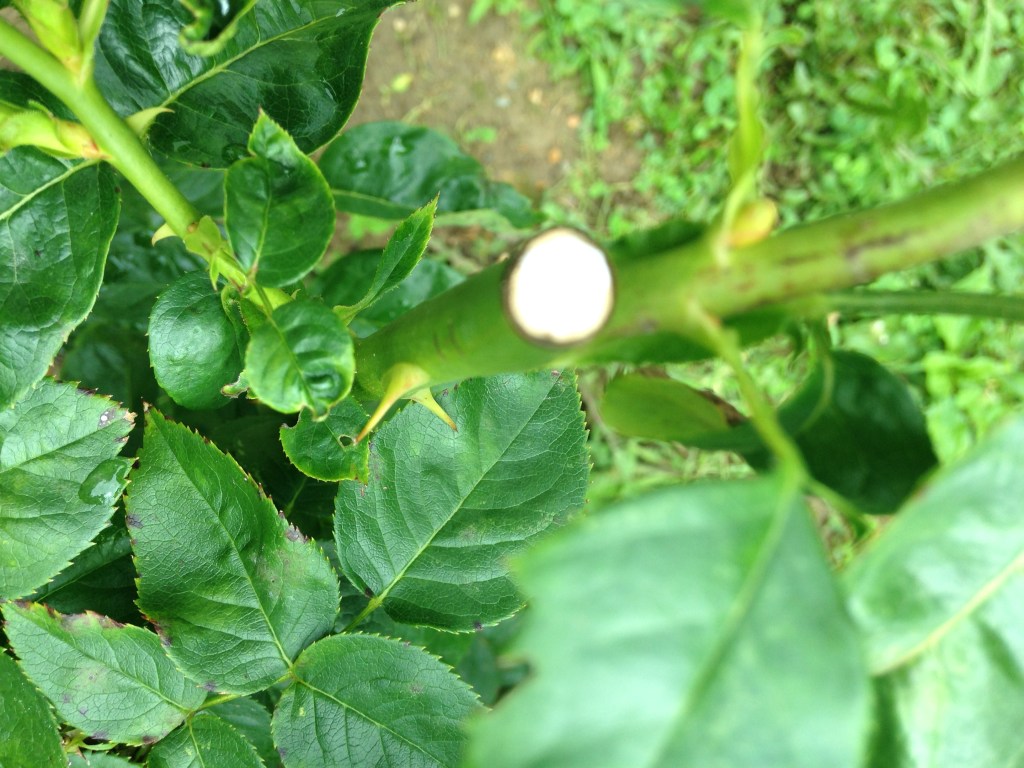
To protect your roses from borers, seal off freshly cut canes with a dab of Elmer’s multipurpose glue. Refrain from using Elmer’s school glue as rain fall or watering your roses can wash off the sealant. Also, in a pinch, you could drop clear nail polish on the end of a freshly cut cane, but be advised chemicals in the nail polish could damage the cane, which defeats the purpose. If you notice the damage of a borer, go ahead and cut back the cane until you reach the healthy filling of a cane. Upon doing so, seal off the end of it. With each cut you make of your canes, dab on the Elmer’s glue so the borers will eventually run out of options.
“Bind this warning, ‘Seal the Torah within My disciples’.” Isaiah 8:16
Elmer’s Glue seals a rose cane.
Smokin’ Hot, a hybrid tea rose.
The internal damage an unsuspecting rose borer does to a rose bush reminds me of how easily the unrecognizable sins of unforgiveness and bitterness creeps within the canes of our soul. I have noticed in my own life, I tend to forgive others for their harmful behavior towards me, but often I fail to forgive myself for some of my own harmful and impacting decisions. Without even realizing it, hints of bitterness borrow deep into my canes. Nightmares and other circumstantial triggers clued me into such a wilting and potentially devastating issue hidden within my heart. Despite knowing God forgives those who repent (Psalm 103; Isaiah 1:16-20, 43:25), I would walk around with self-imposed shame, guilt, and condemnation. While I realize I cannot control the actions of others, I can control my choices. Unfortunately, we must live with the consequences of our choices and one particular decision haunted me for years.
Thankfully, upon realizing God’s love and lavish mercies, I could cut out the bitterness and unforgiveness bored deep within my soul, while sealing my heart and mind with His commandments like we seal the freshly cut cane with Elmer’s glue preventing further damage. When I reflect on His forgiveness, love, and instructions for living, I am free to flourish producing “ever-blooming roses”.
‘Oregold’, a glorious hybrid-tea shines in shades of yellow.
Thistles, Thorns, and Now Thrips?
Nearly every morning I inspect my rose babies looking for damaging insects such as aphids, sawfly larvae, Japanese beetles, and thrips. Thrips, though terribly difficult to see, as are most of these critters, leave obvious evidence on fragrant or light-colored rose petals. By their very nature, thrips thrive by sucking the life out of the rosebud and its petals if they are even able to bloom. This summer I added the wonderfully fragrant, lavender-colored Memorial Day rose to my garden. Just a few feet away I also planted Oregold, another hybrid tea rose, which produces a lovely bloom in vibrant yellow. Unfortunately, Memorial Day suffered from thrips. In a short amount of time, my Oregold rose also succumbed to them. I hadn’t known such microscopic creatures even existed until I noticed my Memorial Day rose petals had a bizarre brown edging. I hoped this delightful-smelling rose bush was suffering from heat exhaustion. But even after thoroughly watering the bush in addition to the temperatures subsiding, shades of brown still smothered her every bud and bloom. Shortly thereafter, my Oregold, who once provided large layers of glorious yellow petals, now was hampered by dilapidated edges of brown or petals that appear dry and shriveled as well as buds that won’t open, all of which are common side effects of thrips.
Consequently, I went to the trusty internet to determine what is plaguing my newly adopted roses. After doing a little research, I took a closer look at my roses and could identify them. Yikes, it’s thrips! To determine just how bad the rose bushes were infested, I took a white piece of paper and tapped the blooms over the paper. Sure enough, the once nearly invisible thrips were now clearly visible though ever so tiny! To ward them off, I hosed them down with water and then gave them regular dosing of neem oil. I prefer to use more organic measures than resorting to systematic insecticide. The infestation of thrips proves yet another example of why beneficial bugs like ladybugs, hoverflies, and lacewings are desperately needed in a garden as they love to feast on such devastating creatures.
“I am the Lord; I called you with righteousness and I will strengthen your hand; and I formed you, and I made you for a people’s covenant, for a light to the nations. To open blind eyes, to bring prisoners out of a dungeon, those who sit in darkness out of a prison..” Isaiah 42:6-7
As I went about decontaminating my roses, I pondered on the simple fact that a light-colored and or fragrant rose attracts such insects. Light, in general, attracts bugs. How interesting that sometimes though as we may live out a lifestyle of worship as the light of the world and emit a sweet aroma as daily living sacrifices, or simply as good, empathetic people, we too can attract pestilence in our lives. It would seem the more you blossom as a fragrant, light-colored rose in God’s garden, those who choose to reject God, His ways, and do evil, find themselves harboring contempt towards you. Perhaps they don’t understand or more specifically, don’t want to understand. In fact, to them, your decision to strive to obey God’s teachings in Torah, which is defined as light (Psalm 119:105-106; Proverbs 6:23) and to live a lifestyle that reflects His light, may be more like a stench in their nostrils than an inviting fragrance.
In particular, have you ever overcome something horrific while giving God all the glory for helping you be victorious? Some would have preferred to see you suffer or succumb to the thrip infestation as it sucked all joy from your petals of praise. Instead, you were willing to be anointed with God’s neem oil, if you will, or you chose to bask in His light rather than the darkness seemingly attacking you. You chose to thrive despite the thrips. You overcame your enemy and walked out of that battle with the enemy’s goods because you, through God’s grace, turned the experience into something beautiful as it molded your character. By doing so, you are emitting the sweet fragrance God enjoys as you triumphantly obey Him through thistles, thorns, and even thrips!
‘Memorial Day’, a highly fragrant hybrid tea.
Update: In 2023, in Maryland’s Zone 7b/8a thrips attacked my white fragrant roses such as Full Sail, Earth Angel, and Bolero. I ended up spraying them repeatedly with Sevin insect spray. This not only beat the thrips (in time) but also Japanese Beetles. I was sure to inspect the rose bushes for bees though and protected my other bee-loving flowers before spraying. I also discovered throughout the gardening season of 2023 that planting basil by my white rose bush seemed to dispel thrips naturally.
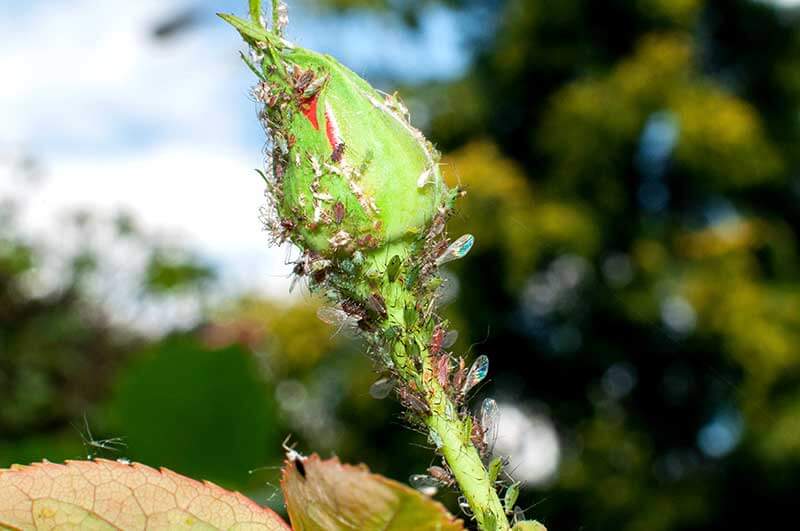
Aphids attack a rose (photo courtesy of GardenTech)
An Aphid Attack
Spring, in all its glory, has a marvelous way of resurrecting my spirit. A spirit that seemingly had lost all hope in the blustery cold winter months. The hints of life burgeoning in my garden stirs renewed hope and energy within my aching bones. How exciting to see new canes sprawling out as if stretching from an oppressing winter! The new red leaves bursting in color declare, “I’m alive just waiting to bestow glorious blooms!”
Irritatingly deceptive are the tiny green aphids that blend in perfectly as they cover an unsuspecting rose bud and other areas of the plant. Technically, aphids may appear in your garden as an assortment of colors such as black, brown, red, or even white. Aphids attack worldwide and their different species are in the thousands! Aphids arrive in the Spring, but can reemerge anytime during rose season seeking out the sap within your rose plant. They tend to cover the rose bud or hide under the plant’s foliage. Aphids can even transmit disease to your other roses. Thus far, every Spring when I look closely at my buds anxious for them to bloom, I am horrified to see a cluster of life sucking creatures curling the leaves around her, smothering her, and doing their best to prevent her from blooming!
Thankfully, there are a few ways to resolve an aphid attack. One such option is to remove them by picking them off and squishing them although this method is quite tedious considering how many aphids typically plague a rose bush at any given time. Another much faster option would be to take a hose with a nozzle and blast off the aphids. This method won’t damage your roses and provides a quick, but temporary solution. Perhaps the best option is to develop an inviting host environment as previously discussed. Various herbs like dill, parsley, and mustard and flowers such as butterfly weed, tansy, Queen Anne’s lace and golden rod will attract ladybugs. Ladybugs thoroughly enjoy a tasty aphid and can devour the colony of pests in no time. You could also purchase ladybugs through an online source and release them into your garden. Follow the directions if you choose this option and understand most of the ladybugs will fly off but some will stay and enjoy the aphid buffet. Considering how aphids will seek out to destroy your burgeoning buds every Spring and into the Summer months, wisdom says to start establishing a welcoming host environment for the good bugs to permanently move in.
‘Peace’, a hybrid-tea
“And now, behold, the cry of the children of Israel is come unto Me; moreover, I have seen the oppression wherewith the Egyptians oppress them.” Exodus 3:9
An aphid attack on glorious roses reminds me of the affliction of the people of Israel, also known as the ancient Israelites and today known as the Jewish people. It seems quite unfair to notice and delight in a flourishing bud, such as God’s chosen people, only to have them smothered by pest likened to antisemitism!
Nevertheless, the Hebrew Bible repeatedly both warns and encourages the Israelites, whether natural born or grafted-in such as Caleb (Numbers 13:6, 14:24, Joshua 14:13-14/Genesis 15:19) and Ruth (Ruth 1:2,8-18), both grafted-in Jews, for example, to not fret and to even expect affliction, but in the end, God will literally save the Jewish people, collective Israel scattered throughout the world raising them to be victorious (see Isaiah 30, 41-42, 49, 53-56, 60; Ezekiel 34-37; Joel 3; Zephaniah 3; Zechariah 8-12 as a few examples).
‘Diamond Eyes’, a miniature rose
“Even though you planned evil against me, Elohim (God) planned good to come out of it.” Genesis 50:20
Furthermore, suppose the oppressed rose bud was crying out to you, the master gardener, to rescue her from such bondage. She was unable to free herself of the smothering aphids but her gardener could. What if we learned to cry out to God, our Master Gardener, rather than try to fight off the aphids ourselves or worse, choose helplessness and hopelessness by giving in to slavery, depression, or fear. Surely, He hears our cries (see Exodus 2:23 and 3:9). Sometimes though, for the greater good and for the bigger picture that we cannot comprehend, it may feel like God, our Abba Father, has abandoned us so we cry out like the Israelites did, which David penned about them stating, “My God! My God! Why have you forsaken me?” (see Psalm 22:1). But ultimately, they were rescued from the oppression of Egypt. We see from the Psalm in verse 5, “To you they cried and were rescued; in you they trusted and were not put to shame.” David also encourages Israel and future readers, to understand the blessings coming to those who trust in the LORD when he scribes, “He trusts in the Lord; let him deliver him; let him rescue him, for he delights in him!” David further encourages the often oppressed and afflicted Israel while prophesizing about future world stating,
“You who fear the Lord, praise Him; all the seed of Jacob, honor Him, and fear Him, all the seed of Israel. For He has neither despised nor abhorred the cry of the poor, neither has He hidden His countenance from him; and when he cried out to Him, He hearkened. The humble shall eat and be sated; they shall praise the Lord, those who seek him; your hearts shall live forever. All the ends of the earth shall remember and return to the Lord, and all the families of the nations shall prostrate themselves before You. For the kingship is the Lord’s, and He rules over the nations..” Psalm 22:24-29
The point, beloved rosebud, is even though Israel or the Jewish people collectively and possibly those who align with them, may be heavily afflicted throughout the centuries, ultimately, God is grooming and preparing a world to come full of victorious overcomers…a world full of “ever-blooming roses”! So whether you need to tediously hand pick those aphids right off of you, blast them off in one clean swoop, develop an environment full of ministering angels, or better yet, simply cry out to your Master Gardener, then just do it! I’m here to remind you, beloveds of God: He hears you. In His strength and His time, you can overcome the attacks of pestilence!
“For his anger is but for a moment, and his favor is for a lifetime. Weeping may tarry for the night, but joy comes with the morning.” Psalm 30:5