
Joseph’s Coat is a multi-colored climbing rose.
Joseph’s Coat is a multi-colored climbing rose.
Perhaps the simplest way to remember basic pruning principles is to memorize the acronym P.R.U.N.E.
{photo credit: Better Homes & Garden}
P: Prepare your plant by thoroughly assessing it. Inspect your rose bush – how did it do over the winter? Any snapped canes from wild winds or heavy snow? Is it a tangled mess? Too overgrown? Damaged? Do you see any diseased canes or problem areas?
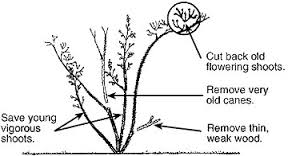
R: Remove the 3 D’s: dead, diseased, and damaged canes. Basically, you’ll need to remove any canes that can’t be trained or saved (as painful as that may be – figuratively or literally).Note: Wear welders gloves and clothes you won’t mind getting snagged. While you are discerning which canes stay and which are cut, you also want to remove any canes that are crossing or too thin (skinnier than a pencil). Watch out for canes that have rubbed along a trellis – they could become susceptible to disease so trim any potential problem laterals/canes out as well.
{photo credit: unknown}
U: Understand your rose bush and the look you want for the plant and how it fits in the overall look of the garden.
N: Nothing left behind -Be sure to gather and evict any remaining dead leaves, canes, or other debris that may be in or around the bush. Otherwise, you will be inviting disease and an unsightly mess of things.
E: Enjoy a healthy, blooming rose bush!
Keep checking Ever-Blooming Roses’ blog for more tips
on developing an ever-blooming rose garden!
Without proper guidance, your climbing rose bush can evolve into a sprawling mess! In this video produced by Heirloom Roses, you’ll learn how to bring out the best in your climber. Soon, I will be doing the same for my climbers! Happy pruning!
Whether (no pun intended) it’s climate change or other factors, it’s always difficult to discern when to prune your rose bushes and when to patiently wait. Ideally, you want to wait until any hints of freezing temperatures in your area are no longer a threat. Pruning wakes up your sleeping beauties and encourages them to get busy blooming. If this process begins and then a freeze stuns them, your rose bushes are at risk of dying or being exposed to other issues. Although, if you have an established rose bush, it will probably recover just fine, but for ones younger than a year or two in the ground, I would recommend holding off on pruning. Better safe than sorry! Personally, I find it always tempting on Spring-like days to get out there and clip away, but the lows at night, not to mention a last-minute snowfall, could seriously damper the fruits of my labor.
With all that said, when is it safe to prune? Some say wait till you see bud eyes swelling or little red leaves popping out.
Forsythia {photo credit: unknown}
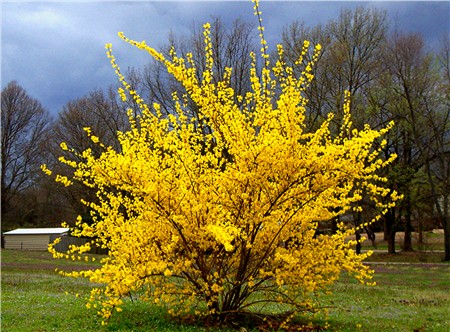
Probably the most reliable indication of when to prune your roses, at least for gardening zones 6-7 such as mine in Pennsylvania and Maryland, is to wait on the forsythias to bloom. When you see those sprawling bushes bursting in glorious yellow, know that it’s time to pull out the pruners!
In the meantime, since you are probably like me anxious to assist your rose darlings before Spring officially begins, you can start clearing away debris and dead leaves that may have congregated in your garden beds. You can also sharpen your pruners and loppers in advance, and stock up on soil, pots, fertilizer, and other gardening supplies. I also call around to see who has the best deals on mulch.
Different regions prune in different calendar months. As for me and my garden, we’ll wait on the forsythia factor!
PRUNING BY REGION
Northeast / Mid-Atlantic: March or April (once)
Southeast: January & August (twice)
Southcentral / Lower Midwest: February & August (twice)
Midwest / Plains: March or April & August (twice)
Pacific Northwest: February or March (once)
Southwest / California: January or February & August (twice)
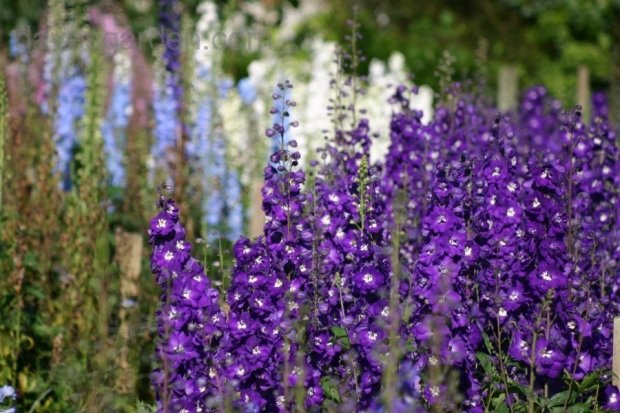
With much anticipation, I long to adopt a few eye-appealing perennials into my family of rose bushes. Nestled within this city, my small urban rose garden will once more delightfully flourish! Soon my hybrid teas, climbers, shrubs, and drifts will swell with new growth as we dance away winter’s frigid blasts of crisp blunt air. As I await such new birth, I find myself perusing a few perennials in shades of blues and purples to (hopefully!) compliment my roses arrayed in yellows, pinks, peaches, corals, creams, and red. Thus far, here is my selection:
Delphinium (Larkspur) Purple Passion {photo credit: unknown}
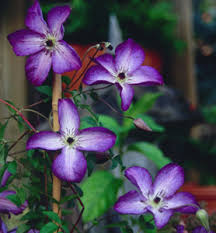
Clematis Venosa Violacea {photo credit: unknown}
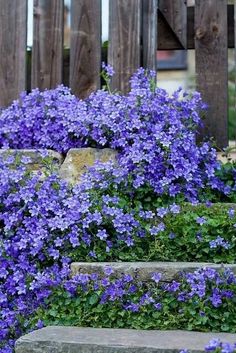
Campanula Bavarian Blue {photo credit: unknown}
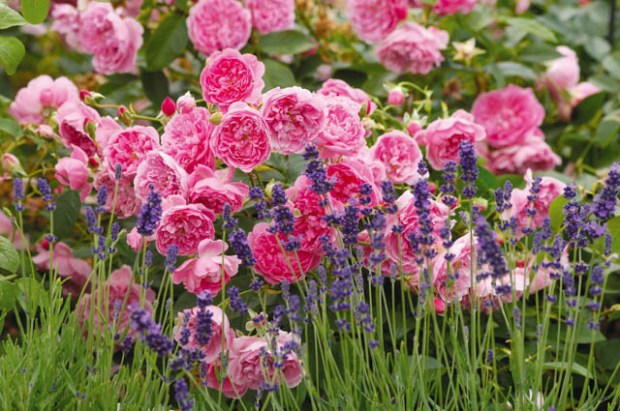
Lavandula (Lavender) Hidcote Blue – The rose is David Austin’s “Harlow Carr”. {photo credit: unknown}
Do you have any of these in your garden? What perennials have you found to add interest and beauty to your roses?
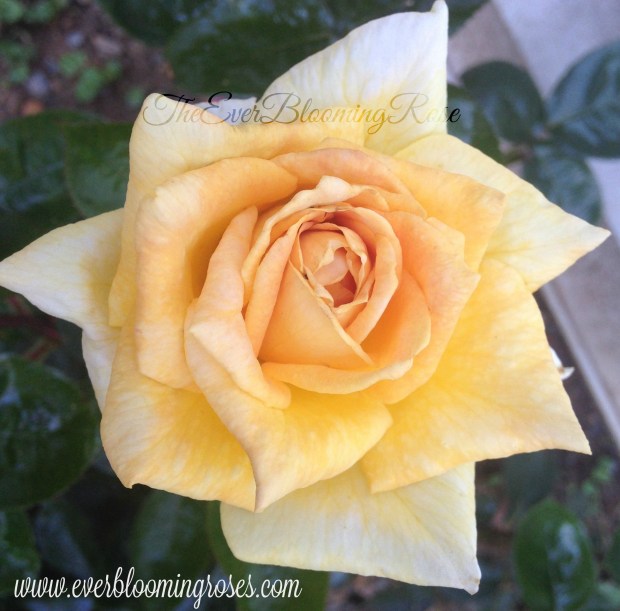
Oregold {photo credit: C.R. Truelove}

{photo credit: Rick Oros on Pinterest}
After the 2016 Blizzard buried my rose bushes in 28 inches of pure white snow recently, my spirits lifted upon seeing glimpses of green Earth once more. It took nearly three weeks to even see that much!
Today, another snow storm, albeit far less intense, glazed my roses yet again. Despite the evidence of freshly snow-laden roses, I find myself counting down the days till Spring…just 40 days to go! It may be cold outside, nevertheless, my heart is warmed knowing Spring is right around the corner.
Growing Horizontally

Fourth of July
Have you ever noticed how climbing roses produce far more shoots and consequently, stunning clusters of blooms when forced horizontal? As a rosarian, I’ve learned if I gently bend the rose’s cane while fastening it securely with string, the cane will produce significantly more blooms than if I let it grow as it pleases. I have to be careful though as the pliable and tender canes can snap. Equally important is the tension of the string. If the string is too loose, it defeats its purpose of guiding the growing cane. Conversely, if the string is too tight, it can pierce the tissue of the cane causing damage or complete destruction. Ultimately, I have the authority as the master gardener to sculpt each cane as I see fit.
“My body and mind may waste away, but Elohim (God) remains the foundation of my life and my inheritance forever.”
Psalm 73:26

Blaze (Note: Blaze is a climber that only blooms in the Spring)
Similarly, once upon a time, this frustrated cane found herself no longer free to grow or go wildly as she pleased. Instead, Jesus, the Master Gardener, placed enough strings to tenderly, but securely force me horizontal through intense back and joint pain preventing me from escaping my bed.
Much to my despair, in a matter of weeks, my full-time income rapidly dwindled to part-time income, then unemployment. My financial stability was seemingly ruined! But God provided and worked everything out for my benefit just as Romans 8:28 promises. Consequently, those difficult days produced a soul harvest I would not trade for any paycheck or even my health.
“I have riches and honor, lasting wealth and righteousness. What I produce is better than gold, pure gold. What I yield is better than fine silver. I walk in the way of righteousness, on the paths of justice, to give an inheritance to those who love me and to fill their treasuries.”
Proverbs 8:18-21
Though uncomfortable, OK, frankly it was miserable at times, I blossomed spiritually and emotionally. Through that season of physical pain, this life slowly, but surely surrendered to His nurturing as He wasn’t hesitant to tackle my prickly thorns one by one. His strings were His boundaries inviting me to grow according to His purpose for my life. I could have rebelled against His plans and His boundaries or I could cooperate. The choice was mine. Thankfully, whether vertical or horizontal, I decided to grow with God’s flow!
 As I perused the internet to assist me in planning out an updated look for my back porch, which overlooks my rose garden, I stumbled upon the creative idea of using white picket fence spindles as the railing. Although I am only researching changes to the outdoor of my home at the moment, these indoor steps certainly invoked my imagination. Much to my husband’s demise, my home decor is adopting more and more of a rose cottage look due to my obvious obsession with roses. Naturally, this idea inspired me.
Equally intriguing is the idea of placing rose wall paper along the back treads of the steps. How charming! 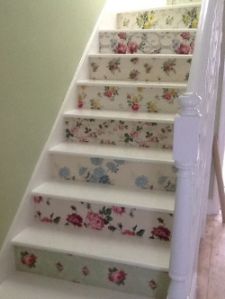 My husband may disagree, however. When it comes to roses, home decor, and planning out my garden, I tend to elaborately dream. Unfortunately, my husband lacks such creativity because he knows he will be the one making such dreams come true. Indeed, Pinterest could be the demise of many marriages! Ha!

